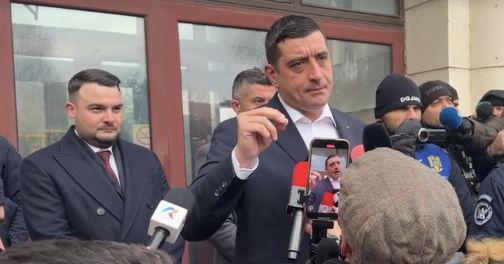
The Prosecutor General’s Office maintains that, by saying “they should be flayed in the public square”, George Simion urged the public to assault, torture or kill the members of the Central Electoral Bureau. As his lawyer, I believe that George Simion is innocent. To assess this accusation, we need to answer two questions. What did George Simion ask the people listening to him on the evening of 9 March to do? And against whom did he allegedly urge them to act?
The case file I have been able to consult so far does not even contain the full recording of the post for which George Simion has been charged. Nor do the documents I have reviewed show that the context in which he spoke has been investigated. In my view, extracting that expression from the sentence in which it was spoken and overlooking what he asked people to do that same evening distorts the meaning of his statement.
Witnesses were questioned before George Simion was informed of his status as a suspect. Today, 26 November, he was notified of that status, and criminal proceedings were formally instituted against him on the same day. What still needed to be clarified when the witnesses were questioned, given that the statement was public and its author’s identity was known? If the evidence gathered by then already justified a reasonable suspicion, what specific risk would it have posed to the investigation for his lawyer to attend those interviews and put questions to the witnesses?
For the accused, equality of arms, as a guarantee of a fair trial, means having a genuine opportunity, through counsel, to test the statements on which the prosecution relies. Given the non-public nature of the criminal investigation, I will not discuss the content of the witness statements here.
The public recordings, however, are available for anyone to watch. Anyone who listens to them in good faith, in the order in which they were made, cannot overlook the repeated appeals for calm. Before the message under investigation, Simion had explained why he was refusing to organise another protest. He could see how angry people were and feared that the demonstration might escalate. Later, while the protest was still taking place, he distanced himself from the violence. Speaking live on television, he said: “I too call on Romanians to take to the streets peacefully.”
As for the people concerned, George Simion referred to “those who carried out the coup”, without naming anyone in particular. The prosecution maintains that this expression referred to the members of the Central Electoral Bureau. In my view, it merely asserts that connection without identifying the specific grounds on which it relies. The essential question for the charge of public incitement also remains unanswered. What words did George Simion use to ask those listening to him to attack the members of the Central Electoral Bureau?
Statements with precedents
During the 2025 presidential campaign, Crin Antonescu said of drug traffickers that “I would shoot them in a stadium”. In the same intervention, he made clear that he did not intend to reintroduce the death penalty. Anyone seeking to understand what the candidate was saying that evening must take both statements into account. Crin Antonescu’s statement on Antena 3 CNN
In 2018, Mihai Tudose, then Prime Minister, said that if the Székely flag flew, those responsible would “fly alongside the flag too”. He later explained that he meant the loss of their mandates and apologised. The National Council for Combating Discrimination found the statement discriminatory and issued an administrative warning. Mihai Tudose’s statement and explanation
In 2023, Diana Șoșoacă spoke from the parliamentary rostrum about throwing political leaders into “mass graves”. In that speech she named, among others, Klaus Iohannis, Marcel Ciolacu and Nicolae Ciucă. Diana Șoșoacă’s intervention in Parliament
Freedom of expression has particular significance in political debate. Article 72(1) of the Constitution provides that deputies and senators cannot be held legally liable for political opinions expressed in the exercise of their mandate. The rationale for this safeguard lies in the separation of powers. A member of Parliament must be able to criticise a public authority’s decision without the prospect of a criminal investigation dictating the terms in which that criticism is expressed.
In George Simion’s case, the charge also has a potential electoral consequence. Article 368(2) of the Criminal Code provides for imprisonment of one to five years and a prohibition on exercising certain rights for the form of public incitement alleged against Simion, subject to the penalty prescribed for the offence allegedly incited. In the event of a conviction, the court determines which rights are prohibited. These may include the right to stand for election and the right to hold a position involving the exercise of state authority. If a prohibition on standing for election were in force at the time of the 2028 parliamentary elections, George Simion would be unable to run.
I am not aware of a precedent, in comparable circumstances, for the accusation brought against George Simion. The statement for which he has been charged had been public since the evening of 9 March 2025. His calls for peaceful protest were equally public. Why is he being charged only now, more than 20 months after that message?